3. Storage and Retrieval
This chapter is a foundational deep dive into how databases actually handle data under the hood.
Database Data Structures
We can implement a simple key-value store with two Bash functions:
db_set() {
    echo "$1,$2" >> database
}

db_get() {
    grep "^$1," database | sed -e "s/^1,//" | tail -n 1
}
The underlying storage format is a text file where each line contains a key-value pair (comma-separated).
-
db_set()appends a new key-value pair to a text file -
db_get()uses grep to find the last occurrence of the key in the file to return the latest value.
The file that we use for storage and retrieval is a log, an append-only data file.
This simple data structure comes with the trade-offs:
- Performant writes: appending to the file is very efficient because it is a sequential operation.
- Poor read performance: The cost of a lookup is $O(n)$, where $n$ is the number of entries.
The solve this, we need an index. This is additional metadata that helps to locate the data. This improves read performance but incurs overhead since we need to write additional structures. Because of this, choosing an index is left to the application developer, using the knowledge of the typical query patterns.
Hash Index
The simplest indexing strategy is to keep an in-memory hash map where every key is mapped to a byte offset in the data file.
- When writing a key, update the hash map with the offset of the data appended.
- To read, look up the offset in the hash map, seek to that location on disk, and read that value.
- Constraint: All keys must fit in available RAM. This makes it perfect for workloads with many writes per key (like a counter), but a low number of distinct keys. This approach is used for Bitcask (the default storage engine for Riak).
Compaction
If we only ever append to a file, we might eventually run out of disk space. The solution is compaction:
- Break the log into segments.
- A background process throws away duplicate keys, keeping only the most recent update for each.
- Segments are merged together to keep the total number of files small.
Practical issues
While our key-value store was simple, there are a number of practical issues that need to be addressed for real database systems.
- File format: CSV is easy for humans to read, but is inefficient for a database.
- Use a binary format encoding the length of a string first, followed by raw bytes.
- This is faster for a machine to parse and simpler to process.
- Deleting records: In an append-only log, we cannot erase old lines.
- Append a special record called a tombstone associated with the key.
- During compaction, it sees the tombstone and knows to discard any previous values for that key, eventually removing it from the new, merged segments.
- Crash recovery: Because the hash map lives in memory, a crash would wipe the index.
- Naive solution: rebuild the index by reading all the segments. For large files, the makes restarts very slow.
- Bitcask optimization: Store a snapshot of each segment’s has map on disk. When the system reboots, it can load the snapshots into memory, which is faster than a full scan.
- Partially written records: A carsh can happen while the database is writing a record.
- Detect the partial entries using checksums that are included in the file.
- When detecting a corrupted record, it can safely ignore that partial entry.
- Concurrency: handling multiple users at once is a classic database challenge.
- Single writer: many implementations use a single writer thread to avoid ace conditions.
- Multiple readers: The data segments are immutable, so many threads can lead simultaneously without locking.
Tradeoffs
It might seem wasteful to never “overwrite” data in place, but it offers many advantages:
- Sequential writes: Appending is much faster than random-access writes, especially on hard disks.
- Simpler recovery: These are much simpler if segment files are immutable.
- No fragmentation: Periodically merging segments prevents the data files from getting fragmented over time.
There are still some limitations of the hash table index:
- The hash table must fit into memory, so it will not work for a massive number of keys.
- Theoretically, we could use an on-disk hash map. But this would perform very poorly since it requires significant random access I/O.
- Range queries are not efficient. It requires looking up each individual key in the range.
Log-Sorted Merge-Trees (LSM-trees)
Sorted String Tables (SSTables) address the limitations of our original log-structured storage by requiring that the sequence of key-value pairs in our segment files are sorted by key.
- Efficient merging: Even if the segment files are larger than the available memory, we can merge them using a technique similar to merge sort.
- Read multiple segments side-by-side, look at the first key in each, and copy the lowest key to a new output file (similar to mergesort). This produces a new merged segment file that is sorted by key.
- Sparse index: The in-memory index can be sparse since it only needs to store the offset for the start of each segment.
- Block compression: Since search requires scanning within the segment range, we can group records into compressed blocks before writing them to disk.
- The sparse index points to the start of these compressed chunks.
- Efficient range queries: Since the keys are physically adjacent on disk, range queries become a simple sequential read.
Constructing and maintaining SSTables
Our incoming writes can occur in any order, so we need an additional structure to maintain the sort.
- When a write arrives, it is added to an in-memory balanced tree structure (like a red-black tree), called a memtable.
- Once the memtable grows past a certain size threshold (a few megabytes), it is written to disk as an SSTable file.
- While the old memtable is being written to disk, a new memtable instance handles incoming writes.
- To find a key, the storage engine first checks the memtable to see if the key is in-memory. Otherwise, it checks the SSTable segments (starting with the most recent segment, then the next-older segment, etc).
- A compaction process runs in the background to combine segment files and to discard overwritten or deleted values.
One scenario we still need to handle is the case where the database crashes. In this case, everything in the memtable is wiped out since it hasn’t been written to an SSTable yet. To resolve this, we use an append-only log corresponding to each memtable. - Each write is appended to an unsorted log before being added to the memtable. - If the system crashes, the database reads to log to rebuild the memtable. - Once a memtable is flushed to an SSTable, the recovery log is deleted because the data has already been persisted.
This whole scheme—memtable + recovery log + SSTables + background merging—is a Log-Structured Merge-Tree (LSM-Tree).
Bloom Filters
The biggest performance bottleneck in an LSM-tree occurs when you search for a key that does not exist in the database.
- Because the data is spread across the memtable and multiple SSTable segments, the engine has to check the memtable, and then every segment on disk before it can detect that the key is missing.
- This leads to many unnecessary and expensive disk reads.
A Bloom filter is a memory-efficient data structure used to approximate the contents of a set.
- When a key is added to the database, it is “hashed” several times, and the corresponding bits in a bit array are set to $1$.
- If we check the filter for a key and any of the bits are $0$, the engine knows that the key is not in the database.
- If all the bits are $1$, the key is there with some probability. There is a change of a false positive, but the engine can fall back to a standard disk scan in those cases.
False positive rate
Suppose we have a bit array of size $m$ and $k$ independent hash functions.
The probability a specific bit is still $0$ after $k$ hashes for $n$ elements is
\[\left(1 - \frac{1}{m} \right)^{kn}.\]Using the identity $\lim_{x \to \infty} \left(1 - \frac{1}{x} \right)^x = \frac{1}{e}$, we can approximate
\[\left(1 - \frac{1}{m} \right)^{kn} = \left(1 - \frac{1}{m} \right)^{m \cdot \frac{kn}{m}} \approx e^{-kn/m}.\]Thus, the probability a bit is $1$ is given by
\[1 - e^{-kn/m}.\]Finally, the false positive rate $\epsilon$ is the probability that all $k$ bits for a new element are already set to $1$. This is given by
\[\epsilon = \left( 1 - \left(1 - \frac{1}{m} \right)^{kn}\right)^k\approx \left(1 - e^{-kn/m}\right)^k.\]B-trees
While LSM-trees are gaining popularity, B-trees are the most widely used indexing structure and the standard implementation in almost all relational databases.
The core difference between the two has to do with how they organize data on disk:
- LSM-trees break the database into variable-size segments (several MBs) and write them sequentially.
- B-trees break the database into fixed-size blocks/pages (4 KB in size).
A B-tree lookup starts at a single root page.
- Each page contains keys and references to child pages. Each child is responsible for a continuous range of keys.
- The number of references in one page is the branching factor. In practice, this is typically several hundred.
- Because of the high branching factor, a massive database can be navigated in a tree only three or four levels deep.
- A 4-level tree of 4 KB pages can store up to 256 TB.
To update the value for an existing key in a $B$-tree:
- Search for the leaf page containing the key, change the value, and write that page back to disk.
- If a new key is added and there isn’t enough space in a page, it is split into two half-full pages.
- The parent page is then updated to account for the new subdivision of key ranges. This ensures that the tree remains balanced with a depth of $O(\log n)$.
Because B-trees overwrite pages, a crash during a page split is dangerous—it can leave the index corrupted (an “orphan” page with no parent).
- To make the database resilient, B-trees use a write-ahead log (WAL).
- This is an append-only file where every modification is written before it is applied to the tree pages.
- The database can use this log to restore the tree to a consistent state.
Since multiple threads might access the tree simultaneously, B-trees protect their data structures with latches to provent a thread from seeing the tree in an inconsistent state during a split.
B-tree optimizations
B-trees have been the industry standard since the 1970s and engineers have developed several optimizations for extra performance and reliability.
Copy-on-Write (Shadow Paging): Instead of overwriting a page in-place and relying on a WAL, some databases (e.g. LMDB) use copy-on-write:
- A modified page is written to a new location on disk.
- The database then creates new versions of parent pages that point to this new location, cascading up the tree.
- This is helpful for snapshot isolation: readers can continue looking at the old version of the tree while a writer is busy creating a new one.
Key Compression (Abbreviation): Increase the efficiency of each page by reducing the space each key takes up.
- Interior pages don’t need the full key. They only need enough information to act as a boundary between pages.
- By packing more keys onto a single page, we increase the branching factor and reduce the depth.
Sequential Layout: In a standard B-tree, pages can be scattered anywhere on disk. This is inefficient for range scans because every new page might require a random disk seek.
- Many implementations try to lay out the tree so that leaf pages appear in sequential order on disk.
- Maintaining this order is very difficult as the tree grows and pages split.
- By contrast, LSM-trees have an advantage since the merging process naturally rewrites data in large, sequential segments.
Sibling pointers: To make range scans faster, many B-trees add extra pointers that aren’t part of the strict tree hierarchy.
- Each leaf page can contain a reference to its sibling pages to the left and right.
- This allows a query to scan across the leaves in order without having to jump bank up to the parent pages for every new range.
B-Trees vs LSM-Trees: Architectural Trade-offs
1. Write Path & Throughput
- LSM-trees turn random writes into sequential I/O by buffering in a memtable and flushing to disk periodically.
- B-trees require at least two disk writes for every transaction: once for the write-ahead log (WAL) and the writes for updating the index.
- B-trees have higher write amplification since they operate using a page layout. Updating 10 bytes still requires writing a full 4KB page. LSM-trees have lower amplification, but they pay the cost later during background compaction.
2. Read Path & Predictability
- B-trees have better read performance because every key lives in exactly one logical location. This leads to $O(\log n)$ lookup times.
- The keys are fragmented for LSM-trees, so it requires checking the memtable and then potentially many SSTable segments for a given key.
- LSM-trees can suffer from compaction interference. If the background compaction thread falls behind or saturdates disk I/O, it can cause sudden spikes in request latency that are hard to debug.
3. Storage Efficiency
- B-trees suffer from internal fragmentation (unused space inside a page after a split) and external fragmentation (pages scattered across disk).
- LSM-trees are more compact because they don’t use fixed-size pages. By rewriting data into new segments, they effectively “defragment” the database constantly. Because the index is sorted, the SSTables are highly compressible.
Other indexing structures
1. Multi-index structures
- While a primary key uniquely identifies a row, secondary indexes are non-unique. They are helpful for filtering by attributes (e.g. find all users in Mumbai).
- Databases handle non-unique keys by either storing a posting list (a list of row IDs for each key) or by appending the row ID to the key to force uniqueness.
- Every secondary index added to the table incurs additional write overhead, since inserting an entry requires updating the primary index and potentially $n$ secondary indexes.
2. Index Physical Layout
- Heap files (non-clustered): The index stores a pointer to a location in a central “heap”.
- This is efficient for updates that don’t change the key (only the heap is modified).
- It requires an extra hop to get to the actual data, which can hurt read performance.
- Clustered index: The row data lives inside the index (usually the primary key).
- Faster reads because there is no extra hop from the index to a separate heap file.
- Higher write overhead and increased storage requirements due to the data being embedded in the index.
- Covering index: A “lite” version of clustering that only stores a few extra columns inside the index.
- If the query asks for columns that are already in the index, the database can answer the query without looking at the main table.
Multi-column indexes: Some queries require multiple fields simultaneously.
- Concatenated index: Combines fields into a single key. This is useful for queries matching the prefix of the index but useless for searching by the second column alone.
- Multi-dimentional indexes: Essential for geospatial data. A standard B-tree cannot efficiently handle 2D range queries.
- Specialized spatial indexes such as R-trees or Quadtrees are used to index areas rather than points.
Column-Oriented Storage
For analytic queries that only need 4 or 5 columns out of a 100-column wide table, a row-oriented engine must still load every row from disk into memory. The engine has to parse these wide rows and filter out the vast majority of attributes, which is a waste of I/O and time.
Instead, column-oriented storage stores all values from each column together in separate files.
- A query only needs to read and parse specific columns required for that query.
- The database can reassemble a row $k$ by taking the $k$-th entry from each individual column file.
Compression
Bitmap encoding: when the number of distinct values in a column is small relative to the total number of rows, we can compress the values into a bitmap.
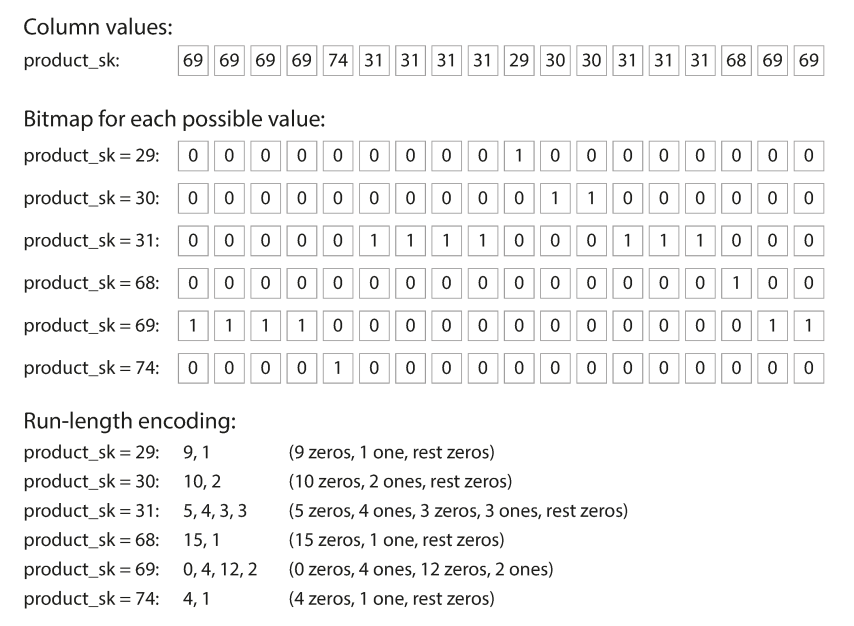
The database creates a separate bitmap for every distinct value in the column.
- Each bitmap has one bit for every row in the table.
- The bit is set to $1$ if the row contains the specific value, and $0$ otherwise.
When the number of distinct values is very large, the bitmaps will be sparse. In that case, we can use run-length encoding which makes the representation of the binary value string more compact.
Hardware Acceleration
Column-oriented storage has immediate benefits due to reading less data from disk (less I/O), but the columnar systems are also designed to be CPU-efficient.
1. Cache Locality
- Because columnar storage stores uniform data types sequentially, a single 64-byte cache line fetch from RAM is packed with relevant data.
- Compression also allows the engine to fit 10x-100x more useful rows into the L1/L2 cache than a row-oriented format.
2. SIMD
- Modern CPUs feature SIMD instructions that allow a processor to perform a single operation on multiple data points simultaneously.
- Because a column is a contiguous array of the same type, the CPU can load a vector of values into a wide register and process them in a single clock cycle.
- In a row-oriented system, SIMD can’t be used as easily because the column of interest is interrupted by other irrelevant columns.
3. Vectorization Columnar engines typically process large vectors of data (typically 1k-4k rows) at once.
- In a row-oriented system, processing a single row requires more complex code: checking data types, handling null data, function calls. In a vectorized loop, these checks are done once for the entire vector, drastically reducing the number of CPU cycles spent on bookkeeping.
- CPUs use branch prediction to guess the path of if/else statements. Row-oriented logic is full of unpredictable branches, which leads to pipeline bubbles when the CPU guesses wrong. Vectorized tight loops are perfectly predictable, allowing the CPU to saturate its execution pipeline.